SeaClever™
Worldwide maritime intelligence and supply management platform monitoring the entire global commercial fleet in real time — powered by a self-training AI that predicts ship schedules, bunker windows, drydocking events, and supply opportunities across every ocean basin, with an integrated CRM-driven sales and after-sales layer.
SeaClever™ ingests continuous AIS (Automatic Identification System) position data from satellite and terrestrial receivers covering the entire world fleet — approximately 100,000 vessel position updates per minute. Raw AIS messages are consumed via Apache Kafka topics (partitioned by MMSI prefix for geographic locality), decoded, validated, and enriched in real time by Apache Flink stateful stream processing jobs running with exactly-once semantics and event-time watermarking.
A TimescaleDB hypertable stores the full historical position stream, compressed and partitioned by time and vessel type, enabling millisecond-latency time-series queries across multi-year vessel movement histories.
The core of SeaClever™ is a proprietary ensemble AI model trained on 10+ years of historical AIS data, port call records, charter party databases, and market freight indices.
- Schedule Prediction: A Mixture of Experts (MoE) transformer architecture with experts specialised by vessel type (bulk carrier, tanker, container, Ro-Ro, MPV), trade lane, and port geography predicts port call schedules, repair and survey windows up to 90 days ahead. Top-2 expert gating delivers model quality approaching a 70B dense model at 13B active-parameter inference cost.
- Bunker Demand Forecasting: A Temporal Fusion Transformer (TFT) processes multi-variate time-series inputs — vessel speed, laden/ballast state, charter duration, bunker price indices, weather routing data — to forecast bunker quantity, location, and timing with ±12-hour precision.
- Drydocking Prediction: A Graph Neural Network (GNN) models the port–drydock–vessel–classification society relationship graph. GNN message-passing propagates drydock slot availability, upcoming certificate expiry dates, and historical yard selection patterns to predict drydocking facility, timing, and scope with 78% top-3 accuracy.
- Anomaly Detection: A Flink Complex Event Processing (CEP) pattern engine monitors for vessel behaviour anomalies — unusual speed reductions, off-route deviations, dark periods (AIS transponder off) — flagging events in real time for operational and compliance analysis.
Model inference runs on NVIDIA H200 SXM5 via NVIDIA Triton Inference Server with the TensorRT-LLM backend. Flash Attention 3 (WGMMA + TMA instruction exploitation on Hopper) reduces attention computation memory footprint by 3× for long-sequence vessel history encoding. Speculative decoding with a 1.3B draft model accelerates the main schedule prediction model by 2.8× wall-clock. PagedAttention manages KV-cache across concurrent vessel inference requests with zero fragmentation.
Vessel profile embeddings (generated by a custom fine-tuned E5-large encoder trained on maritime domain text) are stored in pgvector+pgvectorscale. Hybrid BM25 + dense retrieval with cross-encoder reranking powers the supplier-to-vessel matching engine — finding the best-match service agents and supply companies for each vessel call using semantic similarity over port capability profiles, service track records, and cargo type compatibility.
Microsoft GraphRAG is deployed over the port–agent–supplier–vessel knowledge graph, enabling multi-hop relational queries: "find certified LNG bunker suppliers within 12nm of this vessel's predicted anchorage with available inventory on the predicted arrival window."
SeaClever™ manages a global network of qualified suppliers, repairers, surveyors, and agents across 180+ ports. Supplier capability profiles, certifications, pricing, and performance ratings are continuously updated from structured and unstructured sources. The matching engine runs on Flink, triggering supply opportunity alerts within seconds of a schedule prediction update.
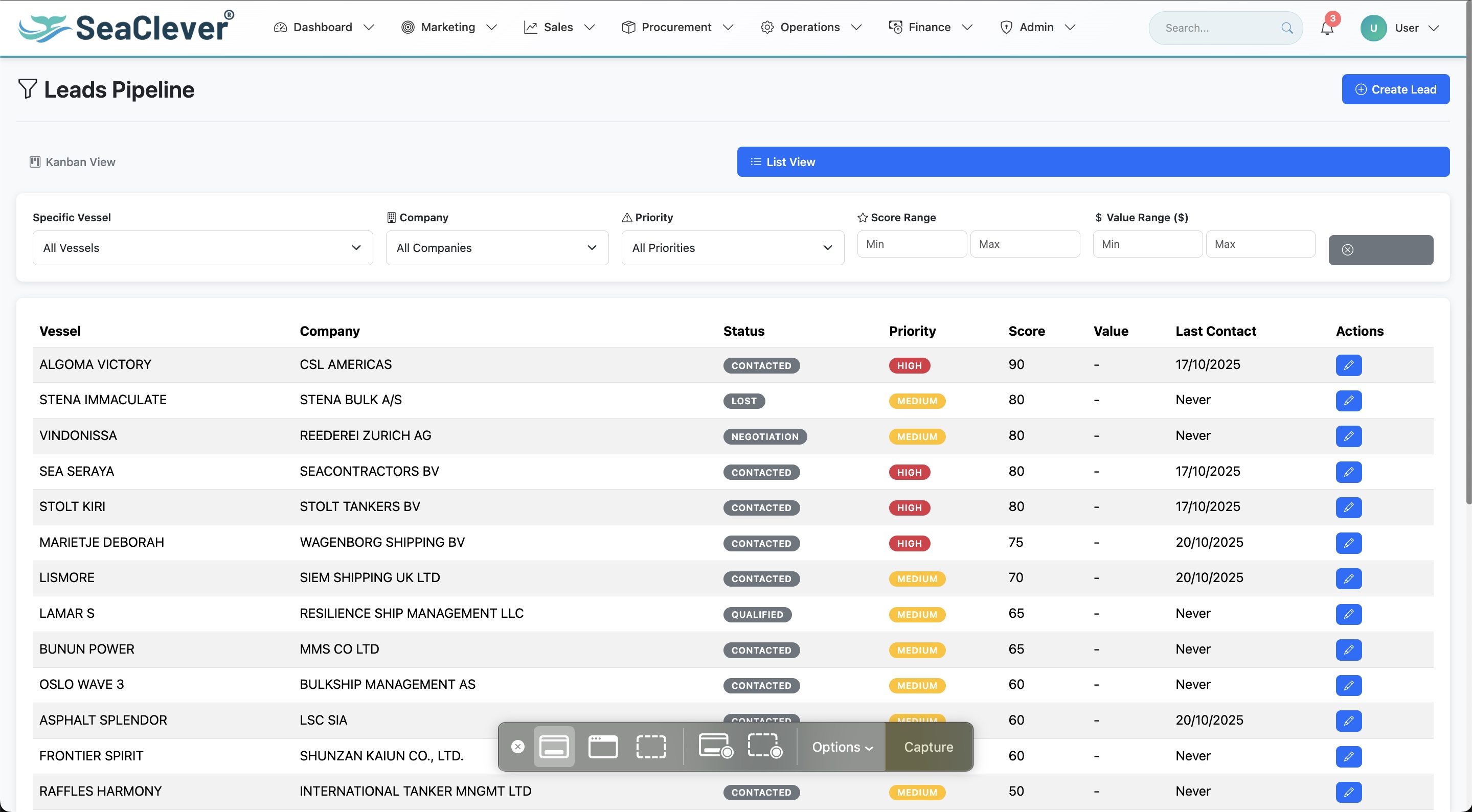
An intensive CRM layer — backed by the AI schedule predictions — automatically prioritises outreach queues by predicted urgency, deal size, and win probability. Natural language outreach drafts are generated via RAG-augmented LLM (RLHF-fine-tuned on successful maritime commercial communications). After-sales support tracking confirms service delivery, captures quality signals, and feeds outcome data back into the self-training loop as DPO preference pairs.